2.27.2006

ArcGIS 9.2 demo at NACIS

Update: ArcNews now has an article on all this by Paul Hardy online.

Original article (Oct. 14, 2005):
Reps from ESRI gave a demo of the new ArcGIS 9.2 cartography capabilities at NACIS. Apparently 9.2 will go beta this December and be in release in 2nd quarter 2006. The cartography design aspects are implemented in what they are currently calling "Representation."

To use, you "convert to representation" and start editing. An Illustrator-like task bar comes up which allow you to edit objects on the map. ESRI emphasized these as personal overrides though, and that you would normally set up rules or sets of attributes for feature classes. This will be core functionality not an extension. So these rules will initiate two extra columns in the geodatabase ("rule" and "overrides").

Representation will also be part of ArcToolbox.

Update: ESRI Q+A at another session with Paul Hardy (phardy@esri.com) and an ESRI person in the audience mentioned the issue of "dicing." Apparently if you export to Illustrator there is a 2,000 node limit, but this can be fixed via an undocumented registry hack. The fix for this and other issues will NOT be in 9.2.

2.26.2006

From l'Etat, c'est moi, to l'etat, c'est George

An interesting paper in Cartographica, titled somewhat obscurely "From l'etat c'est moi to l'etat c'est l'etat: Mapping in early modern France" has been published by Christine Petto, professor of History at Southern Connecticut State University.

Her argument is that mapping assisted and shaped the way political government shifted from sovereignty (the king, the prince, or l'etat c'est moi) to the (more familiar to us) modern state of government (or l'etat c'est l'etat). Petto's analysis is quite in line with standard history. In the west we've changed from all-powerful sovereigns to elected government in one form or another. In the USA, you could even say the Revolution was all about throwing off the dictatorship of the (foreign) ruler George III, and asserting this self-governance of the people. Goodbye to the sovereign!

I wonder then, what we are to make of the John Yoo theory of government? In case you've never heard of him, Yoo was Deputy Assistant Attorney General in the Bush Whitehouse and he wrote his memo in the wake of 9/11. Basically it argues that all power in wartime rests in the Executive, that is, the office of the President:

"In both the War Powers Resolution and the Joint Resolution, Congress has recognized the President's authority to use force in circumstances such as those created by the September 11 incidents. Neither statute, however, can place any limits on the President's determinations as to any terrorist threat, the amount of military force to be used in response, or the method, timing, and nature of the response. These decisions, under our Constitution, are for the President alone to make."
As First Amendment lawyer Glenn Greenwald points out, this arrogation of powers by the current administration is not a fringe academic theory, but rather its a defining characteristic. The Yoo memo has been used to justify the warrantless wiretapping of Americans, among other things.

It's rather strange that we are facing a situation where the country is swinging back to sovereignty again.

1.21.2006

Mapping today is like blogging

In trying to get a handle on what mapping is today, perhaps the best analogy is to that of blogging:

1. Blogging provides an outlet for knowledge and opinion beyond the MSM.
Online mapping, the geospatial web and outlets like Google Earth provide an outlet for mapping beyond the big map publishers or the state

2. The MSM largely controlled informed opinion and conversation, and were structurally dominated by corporations and were small c conservative, if not big c Conservative
Mapping has historically existed largely to serve the state and the military

3. Blogging invests power in the hands of the everyday citizen, outside the control of academia or the state
Mapping today is largely practiced by the everyday mapper, beyond the reach of cartography textbooks or college classes

4. Blogging does have earlier scattershot pre-computer examples, such as diary and jounral keeping in the nineteenth century
There were earlier independent pre- or non-computer producers and inventors of maps such as Buckminster Fuller, Arno Peters, Bill Bunge

The bottom line then is that like blogging, mapping was controlled by certain vested interests, but is now available to millions with very few entry barriers.

Update: I forgot to add one of my main points:

5. Blogging enables and promotes discussion of local issues, especially in political blogs
Today's mapping likewise allows people to focus on local issues, and not be dictated to by national or government mapping efforts.

1.10.2006

Personalized stamps / stamps as maps


Apparently the latest craze is personalized stamps. You take a digital picture and turn it into a real, working stamp (price increase included).

I saw this on the Sprintpcs website, my cell phone provider.

So I thought: why not have a map in the stamp of the destination? Or, a lat-long at least that was machine readable.

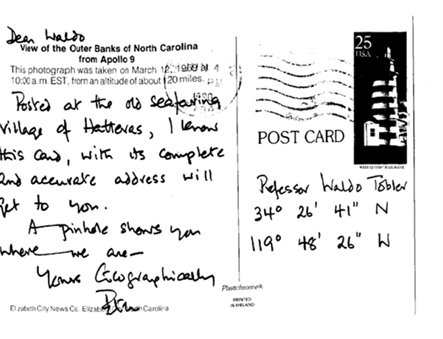
The late Peter Gould, geography professor at Penn State would be laughing right now. During the 1980s he carried out a little test. He got people to send put postcards in envelopes and then send these off to their friends and family overseas. Then all these people around the world would write an address as a lat-long on the postcard! The recipient was Waldo Tobler, his colleague at UCSB.

The idea was to see if any were delivered. Here is Gould's own card:


Neat, huh?

Many of them apparently did make it to Tobler.

Setting up a home wifi network

Over the Christmas break I came across a great offer to buy a CompUSA wireless router for 3 bucks (after rebate, naturally).

It was relatively easy to set up. But I did have to learn some things about networking and wireless that I didn't know.

Here at Ubik HQ we already have DSL service from Bellsouth as well as a wireless enabled laptop (Dell Latitude D600). After plugging in the router (54Mbps, handles 801.11g, a better standard apparently than the 801.11b) we tried to follow the manual, but it appeared to have been translated by a non-English speaker, and was pretty rudimentary anyway. So we ploughed ahead with the settings anyway :)

You need to decide on a network name (aka SSID). Ours is 'ubiknet' of course.
You also should protect your access, and it was with this that we had the most trouble. We chose WEP, which is apparently better than nothing but not great. You also have to choose a key or password. We had two choices: 64-bit or 128-bit. Funnily enough these require passwords that are exactly 5 or 13 letters long!

Next step is to do better than WEP, but am not sure how to do that. Manual no help! I'm not so concerned about neighbors leeching my internet as encrypting my signals. What, me worry? :)

12.18.2005

Ubik in Time's Top 100 All-time Best Novels


Philip K. Dick's Ubik has been listed as Time Magazine's best 100 novels since 1923!

Only natural, I suppose, given the Ubik credo:

"I am Ubik. Before the universe was, I am. I made the suns. I made the worlds. I created the lives and the places they inhabit; I move them here, I put them there. They go as I say, then do as I tell them. I am the word and my name is never spoken, the name which no one knows. I am called Ubik, but that is not my name. I am. I shall always be."

All praise to Ubik!

12.16.2005

$100 laptop arrives


The $100 laptop is finally here. It's green, hand-cranked and has wifi. It was unveiled by MIT Chairman Nicholas Negroponte in Tunis earlier this week. It's positioned as a kids' laptop, especially for developing countries. It runs at about 500MHz.

Most of the software is going to be open-source, so the question is, what would you put on the laptop in order to do interesting mapping or GIS?

Update: The flurry of negative comments on ESRI support over in Spatially Adjusted has resulted in some interesting suggestions, namely that proprietry software should yield to open-source. Has ESRI atrophied due to lack of competition, and will open-source change that?

12.06.2005

Google is the new Ubik

Following form my previous post, one of the most amusing aspects of the novel Ubik is that Dick uses it as an ever-present but ever-changing product (like "ACME" in the old roadrunner cartoons). Ubik toothpaste, household cleaner, underwear etc.

Well, isn't Google the new Ubik? Let's review: Google email, Google maps, Google Earth. Google print library, and Google shopping (Froogle). Google is hiring! They have GIS jobs, and at quite senior levels too.

Finally, guess who owns blogger.com, this blogging company.

12.04.2005

What is Ubik?

Why is this blog called Ubik?

Well in the first place it's named after the Philip K. Dick's 1969 novel. This is a book with the characteristic dark humor and the reality twisting for which PKD is known (he wrote the original stories for Total Recall and Bladerunner, as well as the forthcoming Scanner Darkly, with Keanu Reeves.). The book is about a company specializing in people with "psionic" skills who can nullify other psis, such as telepaths and precogs (think Minority Report, yes, another PKD story).

This "prudence" organization as it's called (they provide privacy in a future world where other people can read your mind) is lead by Gene Runciter. All the psi talent has been "dropping off the map" as we learn at the start of the book. Runciter is awakened at 3:30AM and is not pleased:

Runciter said, "I'll consult my dead wife."
"It's the middle of the night. The moratoriums are closed now."
"Not in Switzerland," Runciter said, with a grimacing smile.
Runciter's wife is kept in cold-pac, a half-life or cryogenic storage. So they all go off to Mars where they're promptly blown up by a bomb. What happens after that is not all that it seems...Runciter is apparently the only one killed and they rush him off to cold-pac. But then reality around them starts regressing back to 1939 and cans of Ubik spray, which may or may not restore reality, are needed to survive. Ubik may or may not be salvation, reality, truth or life.

"Ubik" means ubiquitous, or everywhere. Today we speak of "ubicomp" or ubiquitous computing (a term PKD might have invented). A logical extension is "ubimap," mapping and geospatial information spatially on demand.

Finally, Ubik (the novel) undermines any clear sense of reality vs. not-reality. Already we speak of "augmented reality" or information that has been spatially tagged that appears to us on devices as we navigate around. This is a serious research effort (Ambient Findability has some examples).

12.02.2005

Findability

Findability is the biggest story on the Web today, and its reach will only grow as the tidal waves of channel convergence and ubiquitous computing wash over our shores. We will use the Web to navigate a physical world that sparkles with embedded sensors and geospatial metadata, even as we diminish the need to move our bodies through space. Mobile devices will unite our data streams in an evolving dance of informed consumers seeking collective intelligence and inspiration. And in this ambient economy, findability will be a key source of competitive advantage.
Ambient Findability, p. 13

I can't decide if this is a great new development or a horror story.

Narnia vs. Philip Pullman


Mapheads, this post isn't about maps or GIS so you can safely skip it. I'll post something about "finadability" in a minute.

The movie of C.S. Lewis' the Lion, the Witch and the Wardrobe is coming out soon. I read these books avidly when I was young, only to find out later on that they were a Christian allegory. I remember it was a tremendous shock to me to learn this--I naively read them as a simple fantasy story. I kinda went off them after that. But I am looking forward to the movie.

Anyway, so this fight has broken out between Narnia advocates and Philip Pullman, the author of the His Dark Materials series, a kind of competing children's story that features alternative universes and child protagonists. I don't know if you've read the Dark Materials, but, well, they're dark, and pretty down on established religion. Again I must have read them quite naively because they seemed to me to be pro-faith, if interpreted outside the strictures of the old church teachings. Come to find out though that Pullman is an atheist, who has attacked the Narnia series as quoted in this Chronicle of Higher Ed piece:

In articles, interviews, and speeches, Pullman has described The Chronicles not just as "propaganda in the cause of the religion [Lewis] believed in," but also as guilty of advancing views such as, "Death is better than life; boys are better than girls; light-colored people are better than dark-colored people; and so on." And those are just Pullman's G-rated charges. He also has blasted The Chronicles in public forums as "one of the most ugly and poisonous things I've ever read," "propaganda in the service of a life-hating ideology," "blatantly racist," "monumentally disparaging of girls and women," and marked by a "sadomasochistic relish for violence."
(No source was given for this quote, but I believe it's from this 1998 interview here; see more recently here, and letters here.)

The Chronicle rushes to Narnia's defence, but it's a trash-job on Pullman (the story doesn't allow comments -- old-style MSM or what! -- so I'm replying here instead). Basically I think it's missed the point, The Chronicles of Narnia IS pretty sexist and racist and just by pointing out that it has some strong female characters doesn't change that. These strong characters exist in a world where evil is symbolized by a powerful temptress (remember how she plies Edmund with Turkish Delight?). And then there's the structural sexism throughout the society, with roles defined by sex.

And like Tolkien's Lord of the Rings with its swarthy Ottoman/Turk-like baddies, the baddies in Narnia have dark skin, are cruel, and pray to another god, mocking the Christ figure by dressing up a donkey in a lion skin in order to maintain their hegemony.

So in Narnia, knowledge is bad and heavily fenced (a la Adam and Eve/Eden) and in Pullman knowledge is not sin, but consciousness.

Sounds interesting. Why is the Bible based on the problematic of knowledge? But The Chronicle of Higher Ed. doesn't allow the possibility of appreciating both stories. In order to like Narnia we have to reject Pullman. Well I don't buy that, and I don't buy that Pullman's stories are anti-religious. They're anti-church in the sense that in these other universes the church has ossified and outlawed dissent. But the established church is not = faith, as many Catholics struggling with the new Pope's doctrines show.

Anyway, the story will surely be used by those now co-opting the Narnia stories for their own religious purposes.

And sure enough: this religious website takes delight in trashing Pullman in order to promote Lewis. And they cite the Chronicle of Higher Ed piece as a wonderful defense of Lewis!

11.16.2005

GIS Day at the CDC - not!


I was hoping to attend a day-long series of presentations at the CDC in Atlanta today as part of GIS Day. The CDC have posters and some interesting looking presentations on public health and GIS.

The CDC however requires people to obtain a "sponsor," someone who will meet you and escort you in. However, if you're not an American citizen you have to fill out a form for security a week in advance with passport number, date and place of birth, employer and so on. Despite the best efforts of my CDC contacts, as of 8AM this morning we have not heard back.

So I will miss out, which is disappointing. While I should have contacted the CDC earlier it never occurred to me that a public event at the CDC was so hard to attend!

11.15.2005

Wayfinding and navigability

I mentioned in the previous post that there is a new book out called Ambient Findability. It looks at ways we can find our way through the information overload of today's society.

One of the key points it makes is that wayfinding and navigability through the real physical environment are strong metaphors for finding our way through the noosphere, to use the old phrase of Teilhard de Chardin (maybe we'd call it the blogosphere today).

For what it's worth I did a Masters Thesis on this in the 1980s. I studied both expert and novice wayfinders as they performed a wayfinding task (deciding on a route through an environment as they studied a map). Here's what I found:

1. Experts do wayfinding differently than novices.
Where novices follow a string of beads or trail of breadcrumbs from one known point to another. experts navigate "regionally," paradoxically not by knowing exactly where they are, but with a wider sense of where they are generally.

2. Experts and novices focus on different parts of the task
If you're a novice wayfinder you're much more likely to think in terms of the destination. Experts focus on the route itself.

3. Experts are "enablers," novices are "disablers."
Experts look for aspects of the route that will help them, novices look for aspects that will hinder them.

4. Experts have a richer, more interconnected thought process.
I also looked at how expert and novice problem-solving was structured. I found that experts had a far richer and integrated problem solving thought process than novices, who thought in isolated, disjoint patterns.

5. Experts built in error checking protocols.
Finally, I also discovered that experts often employed error-checking protocols which let them know for instance when they had overshot their destination ("oh, I've reached the stream behind the destination, I'd better go back").

Now this was only a Masters Thesis with limited numbers of subjects, but I've often wondered if these findings would extrapolate to the information sphere.

Neuromancer and Cyberspace

It's been 21 years since William Gibson's Neuromancer came out... cyberspace all grown up now. Who can forget those great quotes:
"sky the color of a television tuned to a dead channel..."
"Cyberspace. A consensual hallucination experienced daily by billions of legitimate operators, in every nation, by children being taught mathematical concepts...A graphical representation of data abstracted from the banks of every computer in the human system. Unthinkable complexity. Lines of light ranged in the non-space of the mind, clusters and constellations of data. Like city lights, receding..."

Great metaphors. I can remember reading Neuromancer the year it came out, 1984, a year I moved from the UK to the USA and the year of celebration of George Orwell's novel. It was a great book. Of course it built on earlier work that was equally influential. Especially the work of Philip K. Dick between the 1950s and 1980s, who practically invented the idea of a consensual hallucination in such works as Three Stigmata of Palmer Eldritch, VALIS, and many others.

Don't forget Vernor Vinge's 1981 True Names as well. Less well known to the public this book affected the computer geeks just as much as Gibson (read their comments on the Amazon comments site, there's one guy who read it at Carnegie Mellon, where Hans Moravec's 1983 computer science class was instructed to read it.)

The problem is, is the concept of cyberspace dead? I don't mean the internet, email etc., but the very idea of a shared experience which is a place in the full sense of the word?

Do we share experience--or is our "virtual" experience actually fractured into millions of little groups, tiny blogs, zillions of 1-1 emails, etc? This is the situation today I think. For example this post goes out on my blog that 10-20 people read every day, via Planet Geospatial. (I'm not complaining: that's 10-20 more people I'm talking to if I wasn't doing the blog, although I can't see your faces, and the flow is only 1-way.)

This is why say Peter Morville's concept of ambient findability is interesting, because he addresses the question of how you find anything, and strategies such as tagging that might aid in "navigating" information.

Second, does it really exist as a place, even a virtual place? Perhaps the real question is whether it is useful to treat it as a place or space. I've always been confused by the use of metaphors here. I'm a big believer that the virtual and the material are and always have been integrated. I don't think for example you can understand the dot-com boom and bust without grasping that.

I'm not against metaphors, especially as they seem to indicate an interesting geography of a new domain. But there's the problem, is it really a singular domain... is there an "it"?

Perhaps there is no cyberspace.

11.14.2005

Do we need a GIS Certificate?

A nationwide GIS Certificate has been in place since January 2004, run by the GIS Certification Institute (GISCI). If you pay $250, demonstrate some GIS experience and sign a Code of Ethics you can become a GIS Professional (GISP).

Developing the Certificate wasn't easy and many people worked hard on it. But not everyone is convinced that it is necessary.

According to Francis Harvey a professor at the University of Minnesota:

achievement of skill-level, point-based certification approaches such as that being promoted by URISA ... can become so nonspecific as to be meaningless for employers looking for concrete measures of job candidates' skills and abilities.
Harvey concludes that such vagueness makes the certificate meaningless by itself.

As a cartographer who sees GIS as part of mapping and not the other way around, it's particularly chastening and dispiriting to see "cartography and visualization" being given such a small "walk-on" part. GISCI should read Keith Clarke's textbook, Getting Started with GIS (Fourth Edition), which shows how GIS has its roots in cartography.

To get a GISCI Certificate, applicants must sign a Code of Ethics. In fact, the code came before the certificate and was being discussed as early as 1993 by Will Craig. At that time, Craig argued that a certificate based on training was worse than a code of ethics that has to do with how someone performs.

Craig also argued strongly for enforcement and sanctions for code violations. As far as I can see, however, there are none in the present certificate. Sanctions in other organizations include private and public censure as well as being disbarred from membership.

The GISCI Certificate and the Code of Ethics seem to me to be seriously deficient. I'm not opposed to either in principle, but a certificate that baldly asserts the irreproachable "scientificity" of its subject, and a Code of Ethics that lacks sanctions and acknowledgement of the power structures of GIS knowledge are, to my mind, divorced from reality.

[Ed. note: The preceding is a shorter version of my GeoWorld column earlier this year. After publishing it I received a bumper load of email on the topic. As this is Geography Awareness Week and GIS Day, it seems timely to bring this issue up again].

11.09.2005

AGS President: We Face Geoslavery

American Geographical Society President Jerry Dobson has warned that we face a future of "geoslavery."

Dobson cited a number of examples such as a school in Sutter California that ordered its children to wear RFID tags around their necks until parents objected and the principal backed down, as well as a similar scheme in Osaka, Japan, or a new law in Finland which permits cellphone tracking of children, and even a case in Kenosha, Wisconsin where a woman discovered her estranged husband had secretly hidden a GPS tracker in her car.

Dobson warns that human tracking will "offer a new form of human slavery based on location control." He acknowledges that human tracking has positive aspects, and wants to see a national debate.

Interestingly, he says that this issue goes far beyond the privacy issues of the sort I posted about below. Who has control? Which technologies are acceptable? Will tracking become a ubiquitous (ha!) tool of control throughout society?

11.06.2005

Domestic surveillance and denunciation letters

A chilling article in today's Washington Post gives new details on the ways we are being monitored.

Nothing new, right? Well hold on... the article says that the government is engaging in a dramatic uptick of domestic surveillance by issuing special national security letters. These letters are secret (if you get one it's a crime to even make them public).

The example they give is a letter they uncovered that was given to a library employee, who was asked to hand over user logs of a public computer: "all subscriber information, billing information and access logs of any person" using the library computer.

These letters, which have been used sparingly since the 1970s have suddenly exploded. WaPo says about 30,000 of these letters are now issued by the FBI every year:

Issued by FBI field supervisors, national security letters do not need the imprimatur of a prosecutor, grand jury or judge. They receive no review after the fact by the Justice Department or Congress. The executive branch maintains only statistics, which are incomplete and confined to classified reports. The Bush administration defeated legislation and a lawsuit to require a public accounting, and has offered no example in which the use of a national security letter helped disrupt a terrorist plot.
The cause is the Patriot Act (of course!). BushCo. have attempted to compare them to Grand Jury subpoenas, but the piece points out that unlike subpoenas, NSLs are aimed not at past activities but at future or potential behavior. In other words they need no prior cause or even illegality, but only the label "bad guy."

Crime therefore is no longer about catching and punishing transgressors, but about predicting and assessing potential future crimes based on risk analysis. Hence "risk society."

Why is a risk society bad? Here are some reasons I thought of:

1. Surveillance switches from the few to the all--since we're all potentially risky. Constant surveillance (including geosurveillance).

2. Death of democracy: "A society in which everyone's actions are tracked is not, in principle, free" (EFF).

3. If we're constantly surveilled, and know we're surveilled, it will chill our behavior and expression.

4. This constant surveillance will probably include geosurveillance and human tracking

One last point. In ancien regime France they had something called lettres de cachet. These letters were denunciation letters issued by the state (the king). Get one of these and you were carted off to prison. They were of course perverted in that they became available for sale in order to deal with troublesome people, people who were unwanted, strange, disorderly, mad, bad, etc. (families would especially buy these to cart off unwanted family members).

National security letters = lettres de cachet?

11.04.2005

Constitutional amendment to protect geo-privacy

Following my earlier note about a new program to implement RFID in our passports, perhaps it's time to start thinking about an actual constitutional amendment to protect privacy, including geo-privacy (the right to control our own locational information).

There's an interesting blog entry about this here. That way we could short-circuit all the debate over whether a right to privacy exists each time we get a Supreme Court nominee. A large majority of Americans are in favor of such a right after all.

10.31.2005

Tracking chips in passports

In his recent book Spying with Maps Mark Monmonier asks if our locational privacy is worth protecting. He documented a number of ways we are under "geosurveillance."

Now comes news that the US government will implement RFID chips in our passports, despite a public comment response that was 98.5% negative. These chips emit a radio signal that carries information about the bearer (just what information is not clear) and the signal can be detected at a distance. Why bother having a public commentary if you just ignore it.

Two possibilities are that the passports will provide tracking information as well as biometric data. Is this really what we want in our own passports? Geotracking information? The problem with these "solutions" is that it makes a suspect of us all. We're all potentially dangerous.

The system, which will be implemented for government employees next month, will start for all Americans in about a year. Not to mention that many visitors from overseas will also be required to have chips in their passports. Just how will that happen? I can't imagine the Netherlands or Germany implementing this (though Blair might).

What is the real reason people actually want this, I wonder.

10.30.2005

An historic picture


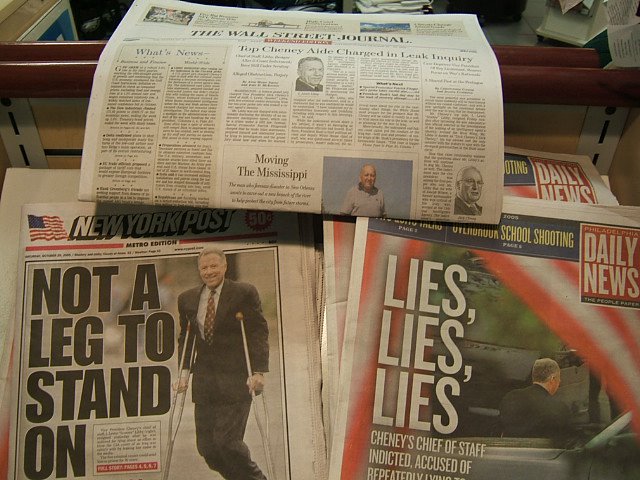
A very historic picture: the headlines after Libby was indicted. I like the contrast between the tabloids and the WSJ. Almost like the WSJ is too embarrassed to report when one of their own is brought down.